Rouen packed Joan of Arc's trial, a cathedral Monet painted thirty times and crooked medieval lanes into one old town built for unhurried city walking tours.
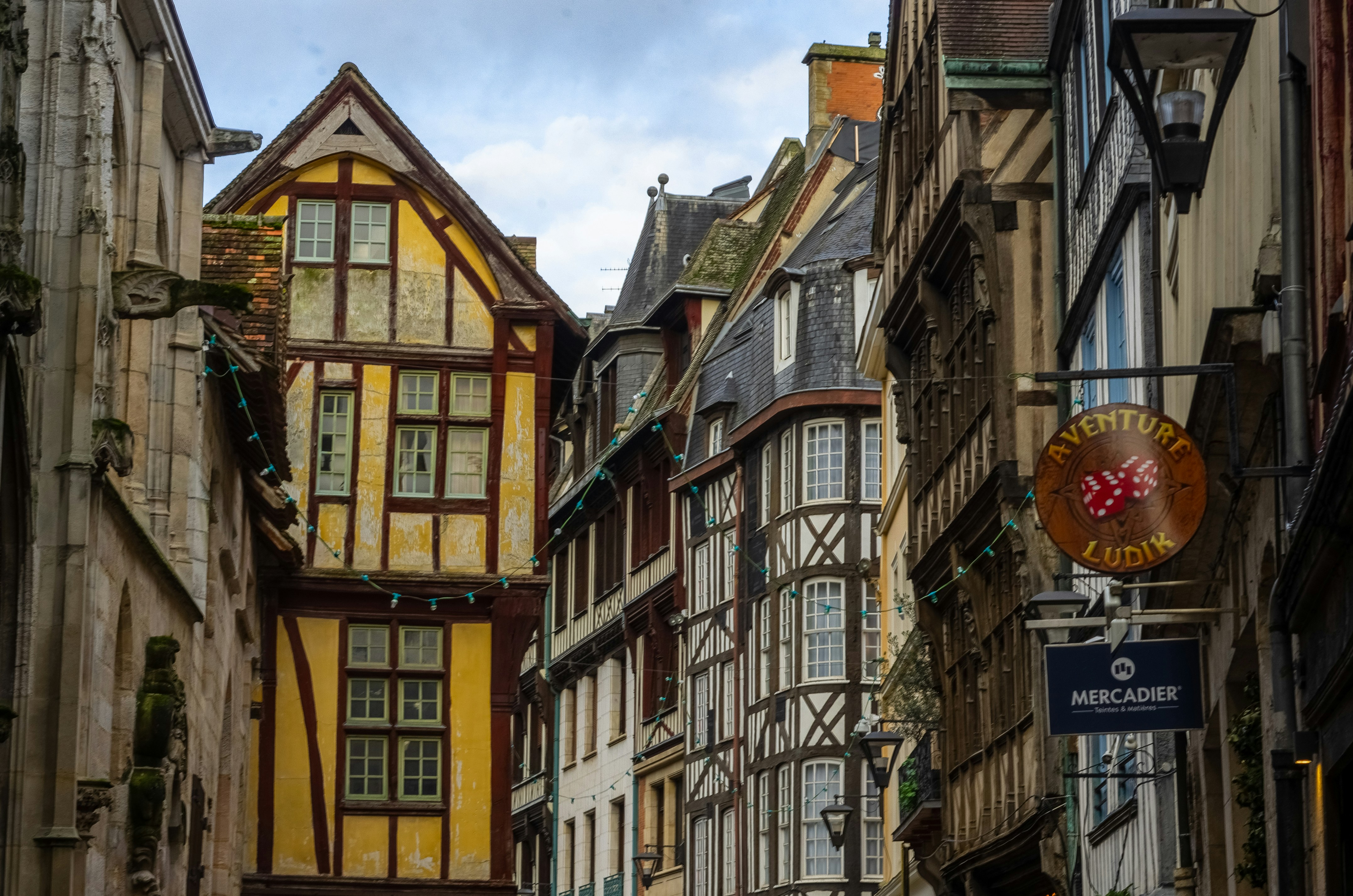
A short train ride north-west of Paris, on a bend of the Seine, sits a city most travellers skip entirely on their way to somewhere flashier. That's Rouen's loss for everyone else and a gain for you. Victor Hugo is said to have nicknamed it the city of a hundred spires, and one look at the skyline explains why: a Gothic old town so dense with half-timbered houses, hidden courtyards and one genuinely astonishing cathedral that you'll lose count of the church towers before lunch. Here's the short version. Rouen is Normandy's capital, an easy direct train from Paris Saint-Lazare, and its compact medieval core rewards exactly the kind of unhurried, self-directed city walking tours that let you wander past the obvious landmarks and actually notice things. Give it a full day if you can, longer if the cathedral gets its hooks into you.
Start there, because it earns the attention. Notre-Dame de Rouen's cast-iron spire reached its full height in 1876 and briefly made this the tallest building on Earth, holding the record for four years before Cologne Cathedral overtook it in 1880. That height is also why Claude Monet kept coming back. He painted the west facade more than thirty times in the early 1890s, chasing how Norman light shifted across the same stone from morning to evening, and one canvas from that series hangs a short walk away in the city's own Musée des Beaux-Arts, usually with a fraction of the crowd you'd fight at the Musée d'Orsay.
Walk five minutes from the cathedral and you're under the Gros-Horloge, a Renaissance clock arch straddling one of Rouen's main medieval streets, its inner mechanism dating back to 1389, older than the Gutenberg press. Climb it in the late afternoon if you can. Queues tend to thin out just as the light turns gold over the rooftops, and the view runs straight down to the spire you were standing under an hour earlier.
Keep walking and the city turns genuinely strange, in the best way. Rue Eau-de-Robec still has a real stream running down its middle, half-timbered facades leaning in on both sides like they're comparing notes, and it's exactly the kind of detail that a good city walking tour uncovers and a map app never will. Rue Martainville, Rouen's old antiques quarter, hides a house so crooked at the corner of Rue Damiette that locals just call it the leaning house. Tucked behind Saint-Maclou church is the Aître Saint-Maclou, a fourteenth-century plague cemetery built once the Black Death of 1348 overwhelmed the churchyard next door, its timber beams still carved with skulls, gravediggers' tools and dancing skeletons. Deeply macabre, or the best free attraction in the city. Possibly both.
Then there's Place du Vieux-Marché, where the story turns properly dark. This ordinary market square, Saturday mornings thick with cheese stalls and Norman produce, is where a nineteen-year-old Joan of Arc was burned at the stake on 30 May 1431, after a trial engineered as much by politics as by faith. A tall cross marks the spot, and the swooping roofline of the modern Church of Joan of Arc nearby was designed to evoke both flame and an overturned Viking longship. Step inside for its real treasure: sixteenth-century stained glass windows from the nearby Church of Saint-Vincent, removed and stored safely before that church was destroyed in the 1944 bombing of Rouen, then installed here. The cathedral holds its own historical oddity too. Richard the Lionheart is buried at Fontevraud Abbey, but his heart, by his own request, was entombed in Rouen. Finish, if you've saved room, with canard à la rouennaise, Rouen's own pressed duck, rich enough to make the walk back to the station feel entirely justified.
Rouen doesn't perform for visitors the way Paris does. It doesn't need to. A city that quietly held the world's tallest-building record, inspired thirty Monet canvases and hosted one of history's most notorious trials isn't short on material, it's just quiet about it. If you're wondering exactly what a self-guided MyGuideGuru route through a city like this actually includes, that's worth a read before you go. Download MyGuideGuru and let it stitch every stop above into one walk, at your own pace, no group, no schedule, just you and a hundred spires.
How many days do you need in Rouen?
One full day comfortably covers the cathedral, Gros-Horloge, Place du Vieux-Marché and the old town's main streets. Stay two if you want the Musée des Beaux-Arts, the Aître Saint-Maclou and a slower pace without rushing between stops.
How do you get from Paris to Rouen?
Direct trains run from Paris Saint-Lazare to Rouen-Rive-Droite in around 70 to 90 minutes. The station sits roughly a 15-minute walk from the cathedral, making Rouen an easy day trip or overnight stop without needing a car.
Where was Joan of Arc executed in Rouen?
Joan of Arc was burned at the stake in Place du Vieux-Marché on 30 May 1431, aged nineteen. A tall cross marks the site today, beside the modern Church of Joan of Arc and a small museum covering her trial.
Is Rouen worth visiting compared to Paris?
Yes, especially if you want fewer crowds with just as much history. Rouen trades Paris's scale for a walkable medieval core, a cathedral with its own record-breaking past, and streets Monet found worth painting thirty times over.
What is Rouen famous for?
Its Gothic cathedral, Joan of Arc's trial and execution, roughly 2,000 half-timbered houses, about half of them restored, and its nickname, the city of a hundred spires, courtesy of Victor Hugo. Find more underrated European city guides like this one on the MyGuideGuru blog.


.png)
.png)
.png)
.png)