Siena's medieval rivalries never ended, they just moved to a horse race. A self guided city tour reveals the grudges baked into every street and piazza.
Siena doesn't really have neighbourhoods. It has seventeen tiny nations, each with its own flag, patron saint and centuries-old grudge, and for about ninety seconds every summer those grudges get settled on horseback in front of the whole city. Turn up expecting a pretty Tuscan hill town and nothing else, and you'll miss a place worth exploring in every season, not just race day.
Here's the direct answer: the best way to understand Siena is on foot, not from a guidebook. A self guided city tour lets you wander from one contrada into the next, noticing how the flags and colours change at borders locals have honoured for eight hundred years, whether or not the Palio, Siena's twice-yearly bareback horse race, happens to be running that week.
Every Sienese person belongs to a contrada from birth, whether they ever set foot in a saddle or not. There are seventeen in total, with names like the Eagle, the Caterpillar, the She-Wolf and the Owl, and each one has its own museum, fountain and colours that turn up on window boxes and bar stools alike. Walk between two contrade boundaries and you'll feel it before you can explain why: the bunting changes, the mascots change, and so does the pride on display. It's less a walking tour and more a slow-motion introduction to seventeen fiercely loyal communities stacked inside one medieval wall.
The Palio di Siena runs twice each summer, on the second of July and the sixteenth of August, and only ten of the seventeen contrade race in any given year, drawn by lot. Jockeys ride bareback, corners are brutal, and falls are common. Here's the detail most first-time visitors miss: a contrada can still win even if its jockey hits the ground. If the horse crosses the line first with an empty saddle, the win counts anyway. It's called a cavallo scosso, a loose horse, and it has settled more scores than any jockey ever managed to.
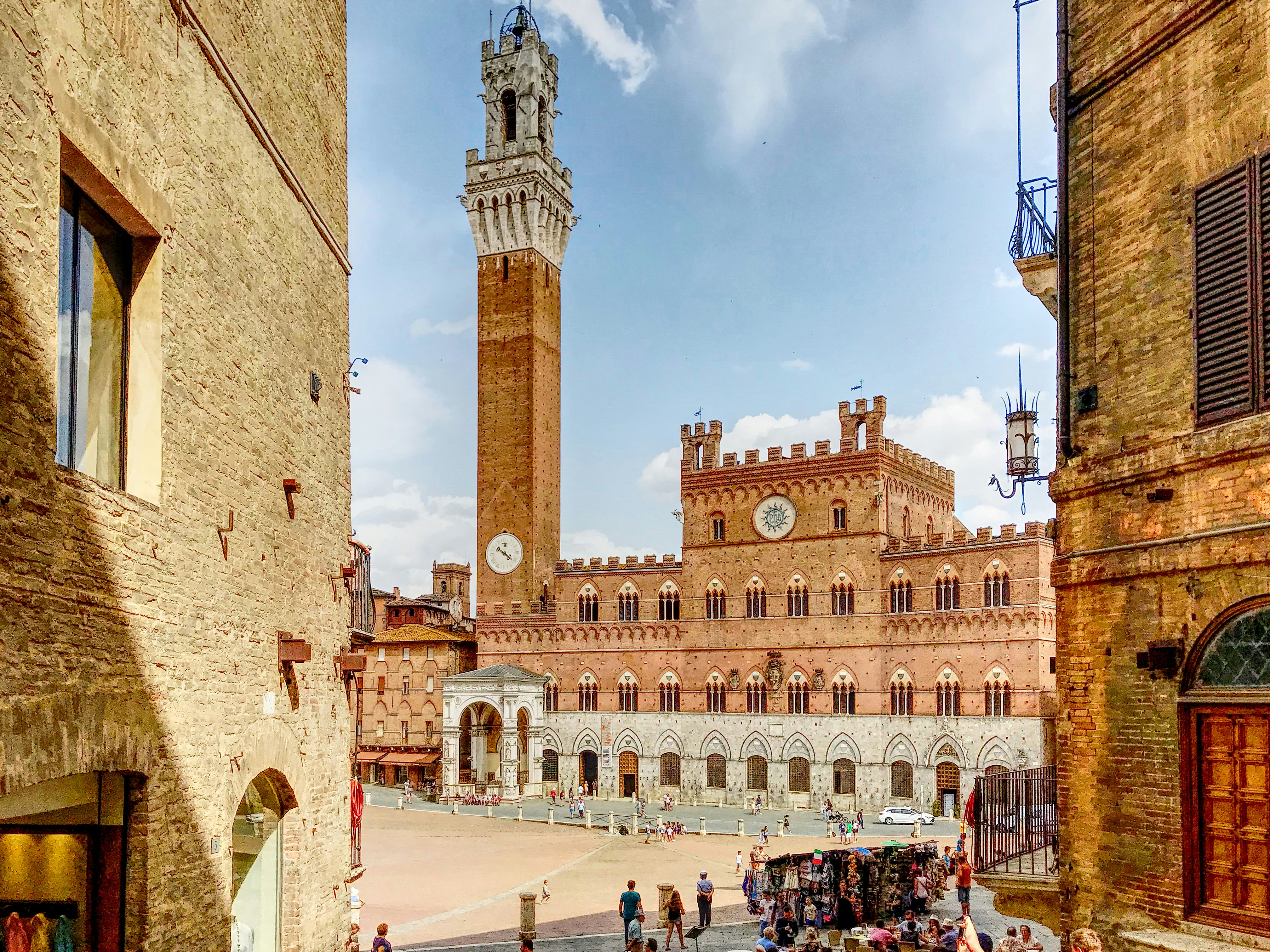
Piazza del Campo gets all the postcards, and fairly enough, it's one of the finest public squares in Italy. Climb the Torre del Mangia on a weekday morning before the tour buses arrive and you'll get the fan-shaped piazza laid out below you almost empty, the red brick paving catching the light before the crowds fill it in. The Duomo di Siena, all black and white marble stripes, rewards the same early timing. If dodging crowds is generally your travel style, we've written a whole guide on how to skip the crowds and actually see a city, and Siena is one of the easier places to put it into practice.
Siena's calendar isn't only about horses. Climb the Facciatone, the unfinished wall of what would have been Europe's largest cathedral, for a rooftop panorama over terracotta roofs and Tuscan hills, with none of the Torre del Mangia's queue. Inside the Basilica di San Domenico sits one of the city's stranger keepsakes: the preserved head and thumb of Saint Catherine of Siena, in a chapel that gets surprisingly few visitors given what's inside it. For something lighter, the Enoteca Italiana pours Chianti and Brunello inside the vaults of a sixteenth-century Medici fortress, and Orto de' Pecci, a walled garden minutes from the centre, has grazing sheep and a rustic trattoria most guidebooks skip. Directly across the piazza from the Duomo sits Santa Maria della Scala, one of Europe's oldest hospitals, its frescoed wards opening onto an underground maze of medieval storerooms that most visitors walk straight past. None of it needs a race on the calendar to be worth the detour.
Outside of race season, the rivalry still shows up in smaller ways: a bar that only serves one colour of scarf, a church that quietly reminds you which saint it answers to, an old man who won't set foot in the district that beat his contrada forty years ago. It's a genuine friction for visitors too, since Siena's medieval core is a warren of narrow, sloping lanes that all look alike, and phone signal drops out fast between the stone walls. That's where a good audio tour guide earns its keep, narrating whichever contrada you've wandered into while offline maps keep you oriented without a signal.
Siena rewards curiosity more than any checklist ever could, and that's the whole premise behind what a MyGuideGuru tour actually includes: personalised routes, immersive audio storytelling and offline access, built for exactly this kind of city, where the best stories hide behind an unmarked church door in a contrada you've never heard of.
When is the Palio di Siena held?
Twice a year, on the second of July (Palio di Provenzano) and the sixteenth of August (Palio dell'Assunta). Both races take place in Piazza del Campo and last less than two minutes, though the surrounding parades and celebrations stretch across several days.
Can you watch the Palio for free?
Yes, standing inside the piazza is free, though it gets crowded and hot with no shade or seating. Paid grandstand seats and balcony views cost more but offer a proper vantage point.
What exactly are Siena's contrade?
Seventeen historic city districts, each with its own name, colours, patron saint, museum and governing council. Membership is for life, usually inherited from birth, and the rivalries between certain contrade go back centuries, often flaring hardest during Palio season.
Is Siena worth visiting outside Palio season?
Absolutely. The Duomo, Torre del Mangia and the Facciatone rooftop view are worth the trip alone, and without race-day crowds you'll get proper time in San Domenico, the Enoteca Italiana's wine vaults and the contrade museums that most Palio-season visitors never see.
How long do you need to see Siena properly?
A full day covers the highlights, though two days lets you slow down enough to wander between contrade without rushing, which is really where Siena's best details live.
What does cavallo scosso mean?
It translates to "loose horse", a horse that finishes the Palio without its jockey still on board. If it crosses the line first, its contrada wins regardless, one of the race's stranger and most fiercely debated rules.
Curious what else a self guided city tour can turn up in a place this old? There's always another door in Siena worth walking through.
Siena has spent eight hundred years arguing with itself over horses, colours and pride, and that's exactly what makes it worth the walk, race day or not. Skip the version of the city that starts and ends at Piazza del Campo, and let a self guided city tour take you into the contrade instead, where the real charm actually lives. Download MyGuideGuru and let Siena tell you its own side of the story.


.png)
.png)
.png)
.png)